Urban agriculture is a hot topic for discussion currently in the wake of African city development. The role of women food entrepreneurs who aim to meet the growing demands of fresh fruits and vegetables in city markets is paramount but they are struggling.
For many years agriculture in urban areas especially in towns and major cities of Kenya has been unthinkable since most of the supply is coming directly from rural areas neighboring the cities. However, through the collaboration of the Centre for African Bio-Entrepreneurship (CABE), Victoria Institute for Research on Environment and Development (VIRED) and the University of Amsterdam, a study was put together to build inclusive business models for food security for city slums in Kisumu (Kenya) and Ouagadougou (Burkina Faso) through the Women Food Entrepreneur (WFE) project.
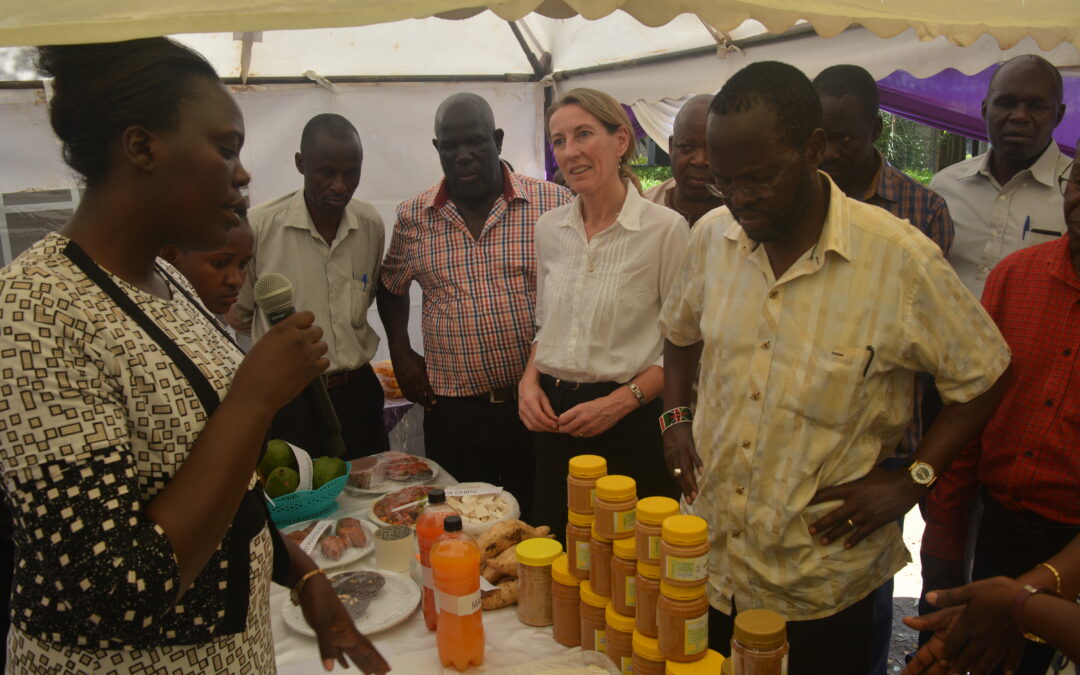
Dr. Nicky Pouw of University of Amsterdam (center) and Dr. Hanington Odame of CABE (right) listens to one of the WFE group farmers from Nyalenda as they toured the various exhibitions at the WFE workshop in Kisumu
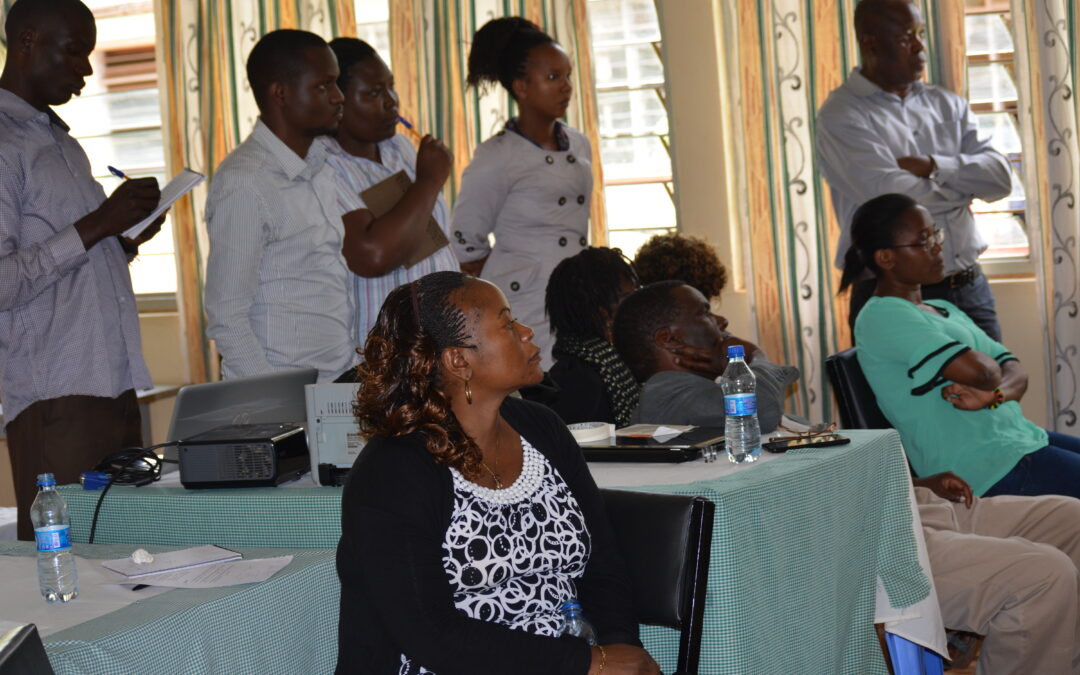
Dr. Nicky Pouw, the project team leader, when presenting about the project’s progress in a stakeholder workshop in Kisumu noted the achievements of the program. She outlined the great steps taken by farmers from various working groups. These include Balaaa group in Obunga to increase productivity using irrigation and improved farming methods; the success of Kibuye waste management CBO whose project of cleaning Kibuye market and making compost manure from the waste and the support the county government department of agriculture is undertaking to provide extension services, basic entrepreneurial training and value addition by means of food processing in the market.
The success story of this project was hailed by the governor who took to address the key policy issues raised by Dr. Nicky. First, he took to acknowledge his admiration of urban farming giving an example of his one-time trip to Singapore where he was amazed at the scale and magnitude of city farming in balconies of city flats making him a champion for urban farming. He also promised, in line with the policy messages, that the ongoing Kisumu geophysical and geo-spatial mapping and planning will take into account the identification and establishment of green spaces for food production and processing.
He also proposed a hybrid system where the green spaces exist within the city and also in the suburbs, through satellite gardens. Though, the Governor had reservations on the policy to promote animal husbandry in the city citing a large number of cattle freely roaming in the streets and causing havoc.
Gov. Anya’ng Nyong’o together with Prof JB Okeyo-Owuor of VIRED (left) addressing stakeholders at the WFE workshop in Kisumu on 14th February 2019 at Wi Pinje Resort, Kisumu.
The steps addressed by the governor opens the way for the various stakeholders in Kisumu, especially the women food entrepreneurs, to be directly involved in the urban planning process and urban development programs. lt is important to learn from their experiences and innovative methods to sustain ‘mini-farming’ in small spaces.
Hopefully, in the future, there is more opportunity to explore new partnerships of women food entrepreneur groups with the county government of Kisumu, Kenya Industrial Research and Development Institute (KIRDI) and the business community (including banks)among others.
In taking this bold move to empower women, urban farmers of Kisumu, Professor the renowned Professor has proved once again as a maverick, that he is among the best governors promoting inclusivity and supporting research and development studies as evidence-base of well- informed policy decisions that will always uplift the city of Kisumu.
In efforts to boost production and marketing, the Venezuelan government has funded the construction of a rice research institute in Budalang’i, Busia county. The Kshs. 400 million institute aims to develop new breeds for lowland rice ecologies and their major market segments, including good grain quality and tolerance to major biotic and abiotic stresses.
Rice is fast becoming a regular food in most Kenyan households. It is a strategic commodity and the fastest-growing food source in Africa.
According to a published post in the local dailies, Busia County will maximize its production through value addition and boost uptake of rice in the market. Also, it will create employment opportunities for the locals and identify the best rice varieties for specific regions in the county.
Previously, Busia farmers were forced to sell their produce at low prices for fear of incurring losses from poor storage and lack of proper mechanized facilities.
Busia will be the only county in Kenya to benefit from the funding from Venezuela Government together with Madagascar Island. Madagascar has already completed its project, while Kenya is still at the design stage. The Ministry of Public Works is expected to hand over the designs to the contractor once complete.
Currently, the consumption of rice is at 440,000 metric tons per year but Kenya is only producing 140,000 metric tons per year, meaning that the rest of the rice is imported to other countries like Pakistan and Thailand.
The Centre for African Bio-Entrepreneurship (CABE) team participated in the international conference on climate change, pastoralism and food security, which was held on August 21-22, 2019 at the Ledger Bahari Beach Hotel – Dar es Salaam, Tanzania.
It was hosted by the Centre for Climate Change Studies (CCCS) of the University of Dar es Salaam in conjunction with the Africa Climate Change Adaptation Initiative (ACCAI). The key issues on the agenda at the conference included:
Urban-rural food system dynamics in the face of climate change;
Reigniting interest in Indigenous Knowledge Systems (IKS) for food security in Africa;
Soil fertility management and farming systems;
Governance, resource conflict, and food systems;
Nutrition and technology for food systems in Africa.
CABE made a presentation on climate change and food security in Kenya at the conference whose theme was ‘strengthen the network for collaboration on climate change and food security in Africa.’
Climate change affects food systems in several ways ranging from direct effects on crop production (e.g. changes in rainfall leading to drought or flooding, or warmer or cooler temperatures leading to changes in the length of the growing season), to changes in markets, food prices, and supply chain infrastructure.
Food systems encompass food availability (production, distribution, and exchange), food access (affordability, allocation, and preference) and food utilisation (nutritional and societal values and safety). Food security is, therefore, diminished when food systems are stressed. However, the relative importance of climate change for food security differs between regions. For example, in Africa, the climate is among the most frequently cited drivers of food insecurity because it acts both as an underlying, ongoing issue and as a short-lived shock.
The low ability to cope with shocks and to mitigate long-term stresses means that coping strategies that might be available in other regions of the globe are unavailable or inappropriate for Africa.
Some of the key findings from the presentation on responding to climate change ravages in Marsabit, Kajiado and Turkana pastoral areas of Kenya include:
Pastoral communities are actively responding to changing climatic conditions;
The communities make unique contributions towards resilience rooted in indigenous knowledge systems and practice:
strategies of maintaining genetic and species diversity provide a form of insurance under a changing climate;
mixed herds serve diverse purposes;
diversified use of landscape, mobility, and access to multiple resources increases the capacity to respond to changing climate;
the traditional system of governance and social networks contribute to the ability to collectively respond to environmental change thus enhance resilience.
Overall, indigenous knowledge systems are evolving and offer a lot, especially for interventions aimed at supporting vulnerable communities.
Some of the policy recommendations that stood out in the presentation was the need to build capacity among pastoralists, women, and youth on how to:
Document and validate indigenous technical knowledge and climate change actions;
Offer technical support on the utilisation of big data on climate change actions to inform planning, budgeting, and monitoring and evaluation (M&E);
Develop capacity on the political economy of policy processes with respect to the devolved system of governance;
Empower women and youth on climate actions and;
Develop a pool of green investments for the water sector in ASAL counties in line with the Nationally Determined Contribution (NDC).
During the event, CABE was invited to collaborate in developing two concept notes on ‘Reigniting interest in Indigenous Knowledge Systems (IKS) for food security in Africa and Policy effectiveness for balancing ecosystems conservation and use in East Africa.’
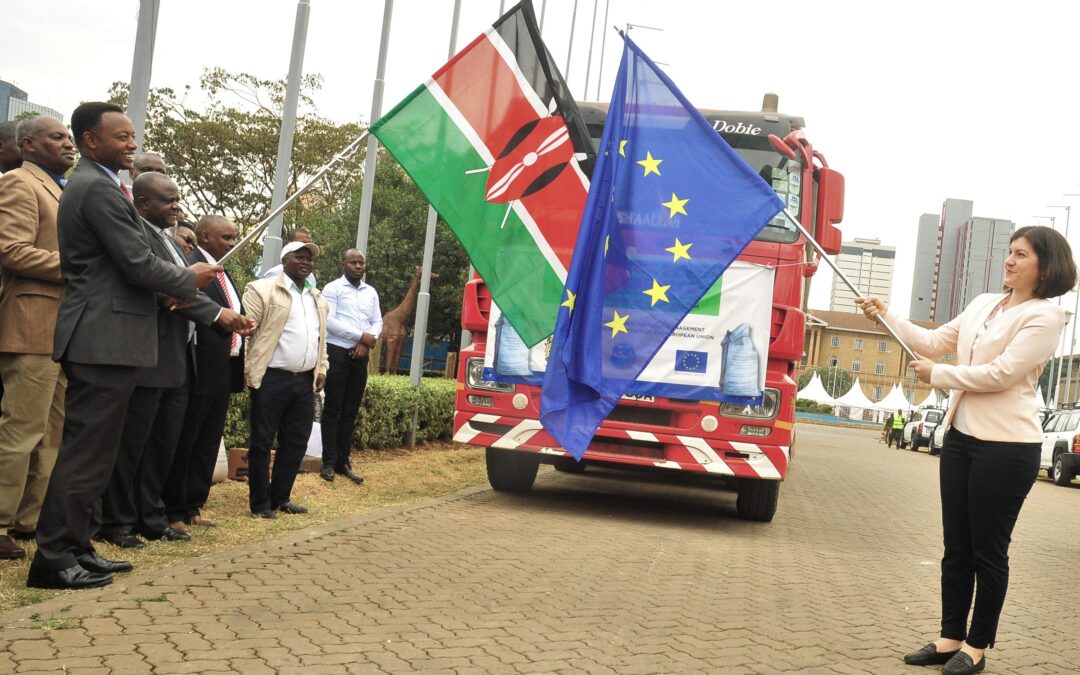
During the month of August, the National Drought Management Authority(NDMA) in collaboration with the European Union flagged off vehicles as well as livestock feed that will help mitigate the ravages of drought within the arid and semi-arid parts of the country.
The state agency in flagged off 8 vehicles t{“type”:”block”,”srcClientIds”:[“8a764d6e-c29f-4846-9711-7729f18ad317″],”srcRootClientId”:””}hat will support NDMA logistics in drought coordination at its headquarters and counties that have the most pressing fleet needs. These are Baringo, Samburu, West Pokot, Lamu, and Kilifi.
Beginning August, the agency has distributed 24,600 bags of the highly nutritious drought pellets. The European Union has supported this intervention to the tune Kshs. 38 million. Priority has been given to the hardest-hit counties of Garissa (10,200 bags), Wajir (8,400 bags) and Tana River (6,000 bags). The demand for livestock feed is likely to increase due to incoming requests by other drought-affected counties.
At present, the drought situation continues to deteriorate in a number of arid and semi-arid counties due to the delayed start and poor performance of the March to May long rains. Cumulative effects of the poor performance of the just-ended long rains and the 2018 short rains have affected the condition of pasture and browse in most ASAL counties.
In February 2019, NDMA began drought response using contingency funds provided by the European Union. Between February and August, the NDMA has disbursed a total of Kshs. 218 million to Baringo, Garissa, Isiolo, Laikipia, Mandera, Marsabit, Samburu, Tana River, Turkana, Wajir, and West Pokot counties to enhance animal health, maintenance of water facilities, fuel subsidies, water trucking, and peace-related activities.
NDMA is an agency of the Government of Kenya mandated to establish mechanisms that ensure that drought does not result in emergencies and that the impacts of climate change are sufficiently mitigated.