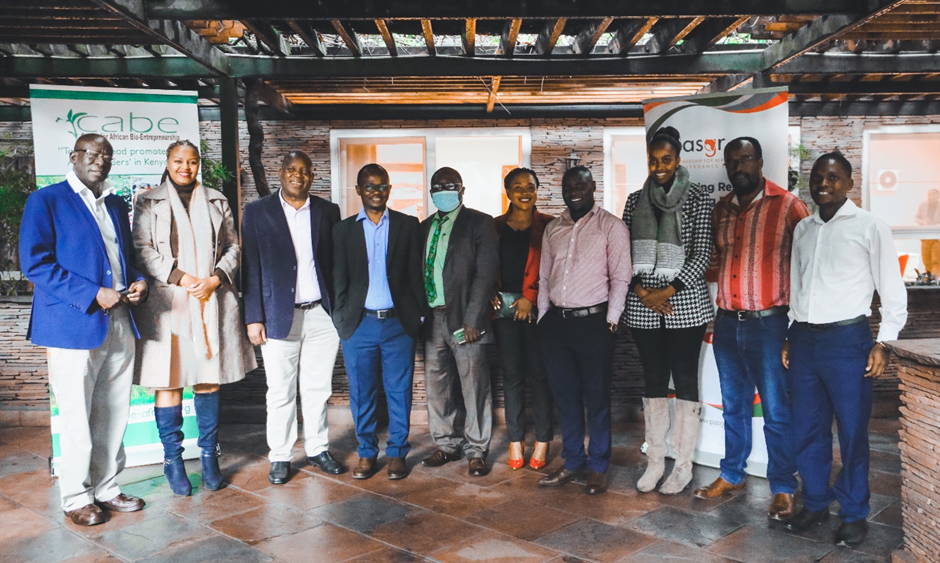
Policy dialogue meeting at Fairview Hotel, 28th April 2022
Africa’s youth population, currently the highest in the world, is expected to double by 2030. High unemployment rates continue to be a major challenge that can turn this demographic group into a ticking time bomb, if left unmitigated. As more people migrate to the cities, the demand for food is substantially growing, creating many employment opportunities in the agriculture and agro-processing sectors. However, these opportunities remain underexplored and under-utilised by the youth and policy-actors alike.
The Utafiti Sera: Youth Employment in Agriculture and Agro-processing in Kenya was inaugurated in December 2017 in Nairobi, Kenya by Partnership for African Social and Governance Research – PASGR (www.pasgr.org ). The project implemented by CABE seeks to use research evidence to enhance policy processes and outcomes on youth employment in the agriculture and agro-processing sectors. The key stakeholders are policymakers in the national and county governments, policymakers in the ministries which work with the youth (Ministry of Agriculture, Fisheries and Livestock Development, training and vocational education institutions), development partners, donors, Non-Governmental Organizations, academic institutions, the private sector, youth farmers and innovators.
The thematic focus of Utafiti sera phase III was inspired by the outcomes of previous Utafiti Sera discussions on Employment in the Sugar and Horticulture industry in Kenya and Nigeria between 2015 – 2017. During these discussions, it emerged that there is limited comprehensive data on youth employment opportunities and best practices, despite the endorsement of many policies and programmes which aim to promote youth employment in Africa. In addition, the youth are often marginalized in conversations on wage employment at both policy and programme level. The programme seeks to address these concerns to bridge the gap between the youth, researchers, and policymakers to identify and promote best practices in youth employment initiatives in agriculture and agro-processing.
The main activities for Utafiti sera phase III aim to bridge the gap between research and public policy. This can be achieved by providing policy-relevant research evidence on what works to promote youth employment; making evidence available to policy makers in user-friendly formats; and providing spaces for discussions to inform government policies and practice which can help tackle challenges of youth unemployment in Africa.
i) Build, facilitate, enhance and sustain a vibrant research-policy community on employment creation and inclusive growth in agriculture and agro-processing.
ii) Synthesize new and existing relevant research evidence on youth employment creation in agriculture and agro-processing and make them available to policymakers and practitioners using policy briefs, newspaper articles, and infographics; and
iii) Engage key policymakers and practitioners through direct contact, policy advocacy and use of productive employment and inclusive growth champions during breakfast meetings, policy debates, workshops, and various other venues.
Biodiversity for Food and Nutrition (BFN) Market Linkages
In Western Kenya, cases of malnutrition, stunting and underweight are common especially for children under five years. This has been attributed to low purchasing power and over-reliance on starchy foods. Yet, Western Kenya is rich in agricultural biodiversity which would provide a gateway to dietary diversity for food and nutritional security. Africa Leafy Vegetables (ALVs) offers such biodiversity which can be exploited not only for nutrition but also economic gains. But this value chain has been under-developed and un-exploited due to production and marketing constraints faced by farmers.
The BFN market linkages project was implemented with the aim of empowering farmer groups to supply markets for nutrient rich foods. An adapted Farmer Business School (FBS) model which applied varied approaches to learning enhanced knowledge sharing among target groups. A total of 547 beneficiaries (151 male, 386 female and 119 youth) from the 25 farmer groups participated in the project. Farmers are better organized, undertake market research and have capacity to respond to new market opportunities. Five farmer groups managed to enter into contractual arrangements with 14 institutional markets comprised of 13 schools and one hospital. The farmer groups developed 23 business plans, which inform their production, financing and marketing plans throughout the year. Farmers are now willing to invest more resources in ALV production and marketing –which will translate into better incomes and livelihoods. Also, most participating households understand and appreciate the nutritional value of ALVs and the significance of a balanced diet.
The project was funded by Bioversity International (https://www.bioversityinternational.org/) through Australian Centre for International Agricultural Research (https://www.aciar.gov.au/).
Create innovations that can enable co-management at the county and national level to work in favor of all stakeholders in the livestock value chain.
Find innovative ways of delivering effective animal health services that are responsive to livestock production, hence enabling them to meet market requirements.
Integrate traditional and modern knowledge on climate change interventions to improve the capacity of pastoralists to adapt and mitigate climate change impacts.
Facilitate innovative financing for the above interventions for the development of the pastoral livestock economy to improve the incomes and livelihoods of inhabitants of pastoral areas.
In addressing these objectives, CABE undertook preparatory activities which will culminate into a national policy dialogue on the above challenges, proven innovations, and the necessary policy support. The project held discussions with stakeholders in Turkana, Kajiado, and Marsabit counties; and the Ministry of Agriculture, Livestock and Fisheries (Department of Livestock Production, Department of Veterinary Services), Kenya Veterinary Board, National Drought Management Authority, and Kenya Meteorological Department.
Notably, the two most critical issues affecting pastoralism, and which should inform national policy dialogue are pastoralism and climate variability, and trade and transboundary diseases.
The project’s achievements
Mapped actors and identified seven kraals as a basis for respectively engaging policy makers and pastoral communities.
Documented and prepared papers and policy briefs on existing climate-smart pastoral practices and innovations, disease surveillance and management and innovative livestock marketing.
Established several avenues (though forums for meetings, print and electronic media) for county-level policy debates and dialogues on animal health, trade, climate smart pastoralism, food security and livelihoods.
Reviewed policies on animal health, climate change, marketing, and trade.
Organised a sub-county policy dialogue comprising 80 stakeholders who provided feedback on policy briefs.
Developed and aired 8 radio programmes on community radio stations through Kraal-based radio-listening clubs initiated by CABE.
The success of Phase I (ReSAHMaP) led to Phase II for hosting a national policy dialogue OF Phase I, then Phase III on Climate Smart Pastoral Innovations (CSPI).
Re-thinking Strategy on Animal health, markets, and policy in Pastoralist Areas of East Africa (ReSAHMaP)
The Centre for African Bio-Entrepreneurship (CABE) is in the third phase of implementing OSIEA Economic Governance program with funding from Open Society Foundation through the Open Society Initiative for Eastern Africa (www.osiea.org).
Dubbed ‘Re-thinking Strategy on Animal health, markets, and policy in Pastoralist Areas of East Africa: Supporting learning by Interaction to strengthen livestock policy and practice in Kenya,’ the project aimed to enhance the capacity of pastoral communities to influence decision making with respect to animal health, markets and policy for improved livelihoods and food security in Kenya.
The main objective of ReSAHMaP was to advocate for policies that will help to improve livestock marketing, animal health, service delivery and climate change mitigation and adaptive capacity in pastoral areas of Kenya.
The project’s specific objectives were to:
Create innovations that can enable co-management at the county and national level to work in favor of all stakeholders in the livestock value chain.
Find innovative ways of delivering effective animal health services that are responsive to livestock production, hence enabling them to meet market requirements.
Integrate traditional and modern knowledge on climate change interventions to improve the capacity of pastoralists to adapt and mitigate climate change impacts.
Facilitate innovative financing for the above interventions for the development of the pastoral livestock economy to improve the incomes and livelihoods of inhabitants of pastoral areas.
In addressing these objectives, CABE undertook preparatory activities which will culminate into a national policy dialogue on the above challenges, proven innovations, and the necessary policy support. The project held discussions with stakeholders in Turkana, Kajiado, and Marsabit counties; and the Ministry of Agriculture, Livestock and Fisheries (Department of Livestock Production, Department of Veterinary Services), Kenya Veterinary Board, National Drought Management Authority, and Kenya Meteorological Department.
Notably, the two most critical issues affecting pastoralism, and which should inform national policy dialogue are pastoralism and climate variability, and trade and transboundary diseases.
The project’s achievements
Mapped actors and identified seven kraals as a basis for respectively engaging policy makers and pastoral communities.
Documented and prepared papers and policy briefs on existing climate-smart pastoral practices and innovations, disease surveillance and management and innovative livestock marketing.
Established several avenues (though forums for meetings, print and electronic media) for county-level policy debates and dialogues on animal health, trade, climate smart pastoralism, food security and livelihoods.
Reviewed policies on animal health, climate change, marketing, and trade.
Organised a sub-county policy dialogue comprising 80 stakeholders who provided feedback on policy briefs.
Developed and aired 8 radio programmes on community radio stations through Kraal-based radio-listening clubs initiated by CABE.
The success of Phase I (ReSAHMaP) led to Phase II for hosting a national policy dialogue OF Phase I, then Phase III on Climate Smart Pastoral Innovations (CSPI).
MANAGING SCARCITY AND PLENTY: TOWARDS CLIMATE SMART PASTORAL INNOVATIONS IN KENYA (CSPI)
The CSPI project builds on the research findings and policy recommendations from the study on ‘Re-thinking Strategy on Animal health, markets, and policy in Pastoralist Areas of East Africa: Supporting learning by Interaction to strengthen livestock policy and practice in Kenya.’ (ReSAHMaP).
The finding revealed that pastoral systems face different challenges which affect their livelihoods despite the potential of pastoralism to be a viable livelihood system for both pastoral and non-pastoral communities in Kenya. In addition, pastoralists in Kenya are often considered to be among the most economically and socially disadvantaged groups in their respective county economies. This is aggravated by the pastoralists’ limited access to government veterinary services, isolation from major consumer markets and other development opportunities. They also face challenges such as trans-boundary animal diseases which have implications on sanitary standards for local and international trade as well as lack of enabling institutional and policy environment to support their way of life.
The CSPI project aims to enhance the capacity of pastoral communities to influence decision making with respect to climate smart pastoral innovations for improved livelihoods and food security in Kenya.
Specific objectives
To build evidence on climate-smart pastoral innovations in disease surveillance and management, innovative livestock marketing and trading initiatives to facilitate learning, uptake, and up-scaling.
To prepare pastoral communities for active participation in the policy debates, dialogue, and action.
To provide spaces/platforms for presenting policy recommendations for appropriate policy actions and uptake of policies either through legislation or to inform program design and implementation.
The project’s approach serves to strengthen evidence on climate smart pastoral innovations, and to build the capacity of beneficiaries to respond more effectively to animal health, climatic change/extreme weather conditions, market opportunities and policy. To achieve this, CABE works through local capacity building providers–to deliver for a fee, services, knowledge and information to beneficiary pastoral communities and other stakeholders at the county level.
The women Food Entrepreneurs (WFE) research is a project under the Dutch Food & Business Knowledge Platform (http://knowledge4food.net/) that aims to strengthen women’s food entrepreneurship in city slums of Kenya and Burkina Faso. It builds on an inclusive business model for food security based on an integrated undertaking of the complex interactions between soil quality, food production, quality and nutrition for vulnerable groups.
This project has a transdisciplinary team of social and natural scientists namely Dutch, Kenyan and Burkinabe collaborating with local stakeholders and community-based women groups.
Through a comparative analysis between Kisumu and Ouagadougou, this research addresses the constraints faced by women as:(i)food producers in (peri) urban gardens, (ii)food processors and (iii) food marketers within diversified physical, environmental, social and policy contexts
The project co-designs and undertakes field tests for hybrid food production, processing and marketing technologies, enhancing and promoting women’s business knowledge and skills through inclusive business models.
Our aim and objectives
The project WFE aims to strengthen women’s food entrepreneurship in city slums in Kenya and Burkina Faso, by building inclusive business models for food security.
Its objectives are:
Boosting women’s production, processing and trading of quality foods in Africa’s growing cities to improve food and nutrition security to vulnerable populations.
Field-testing innovative food production and processing methods, and
Designing inclusive business models for women food entrepreneurs
In November 2015, the project kicked off with a meeting in Kenya. Two social science PhDs (one for Kisumu and one for Ouagadougou) teamed up with one natural science PhD (studying in both locations). Collaboration was sought in each location, through participatory workshops, with three urban WFE groups.
The WFE research projects have developed research-based outputs through co-creation with the WFE groups and local stakeholders, including:
Two seasonal calendars 2016 and 2018
Rock dust analysis report 2017
Soil sample test results 2017
Food and nutrition survey Nyalenda and Obunga 2017
Released a publication on inclusive business titled Governance and Inclusive Development programme group (https://www.sciencedirect.com/science/article/pii/S1877343517300428)
University of Amsterdam, Amsterdam Institute of Social Science Research (UvA-AISSR) & Institute for Biodiversity and Ecosystem Dynamics (IBED), the Netherlands
Centre for African Bio-entrepreneurship (CABE), Kenya
Victoria Institute for Research on Environment and Development (VIRED) Kenya
Etudes Actions Conseils (EAC), Burkina Faso
Dresden University of Technology (TUD), Germany
Royal Tropical Institute (KIT), the Netherlands
Institute de Recherché en Science de la Santé (IRSS), Burkina Faso
Netherlands Agro, Food and Technology Centre (NAFTC Africa)
Bodembergsma, the Netherlands
Food & Business Knowledge Platform, the Netherlands
Netherlands Organization for Scientific Research WOTRO Science for Global Development (NOW-WOTRO), the Netherlands